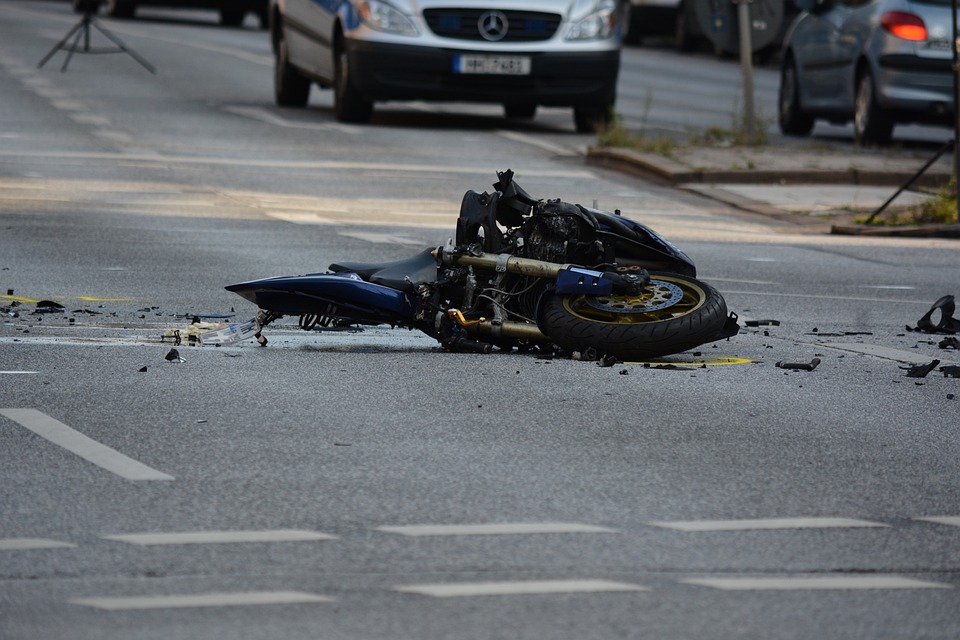
A survey from a personal injury law firm has named the intersection of Route 228 (Berry Road) and Bunker Hill Road in Waldorf among Maryland’s most feared junctions for motorcyclists — a designation that lines up with a real, fatal crash at that same intersection earlier this year.
Personal injury firm Bisnar Chase, which publishes an annual motorcycle safety study, ranked the Berry Road/Bunker Hill Road junction as the second-most feared location in Maryland, behind Gwynns Falls Parkway and Reisterstown Road in Baltimore. The firm’s release describes the risk at the Waldorf intersection as centered on drivers pulling out or turning across Berry Road without correctly judging an approaching motorcycle’s speed.
That description matches what happened at the intersection on April 3, when 64-year-old Scott Beland of White Plains was killed riding his Harley-Davidson through the junction. According to Maryland State Police, a 2008 Infiniti G35 ran a red light traveling eastbound on Route 228, struck Beland’s motorcycle, and fled the scene; the driver abandoned the car on nearby Sharpersville Road. The Chronicle previously reported on the hit-and-run, and as of publication, Maryland State Police say the case remains active and under investigation by their CRASH Team, with the matter expected to go to the Charles County State’s Attorney’s Office for possible charges once a suspect is identified.
What the survey found nationally
Bisnar Chase’s release describes a national survey of motorcyclists on dangerous intersections, highway interchanges and merging areas. Two-thirds of riders surveyed, 67%, said they’ve changed their regular route to avoid a junction that felt unsafe, and 61% said they’ve experienced a near miss at a junction, interchange or merge. Three-quarters of riders said they feel at least somewhat anxious approaching a complicated or congested junction, and 84% said they’d support public safety ratings for major junctions and interchanges, similar to a car’s crash-test rating.
Asked who bears the most responsibility for making junctions safer, riders were split: 27% pointed to drivers, 21% said responsibility should be shared equally, and smaller shares cited state transportation authorities, motorcyclists themselves, local governments, and traffic enforcement.
“Motorcyclists often recognize a dangerous junction long before it appears on anyone else’s radar,” said Brian Chase, the firm’s managing partner. “What is particularly concerning is that 61% of riders have already experienced a near miss and 67% have changed their route to avoid a location they consider unsafe. Those are not abstract concerns.”
A note on the numbers
The version of this release provided to the Chronicle states the study surveyed 3,322 riders nationally. However, the firm’s own published methodology for this study states its motorcyclist sample totaled just 300 respondents nationwide (out of 4,322 total respondents, most of whom were car drivers), and the researchers who conducted the survey caution that the motorcyclist sample is “best read as a directional, qualitative-leaning companion” rather than a basis for precise, state-by-state claims. The firm’s methodology page also does not break results down by state or mention Maryland specifically, despite the release’s claim of “the top 2 most feared locations” in the state. Readers should weigh the Waldorf ranking as one law firm’s marketing-driven characterization rather than a rigorously validated statistical finding — though it happens to align with a documented, fatal real-world crash at the same intersection this year.
Charles County has seen a string of fatal motorcycle crashes in recent years, including a motorcyclist killed on Pennsylvania Avenue in 2024 and a Waldorf teen killed in a 2024 collision.