


Braced for possible bad news in the fall, East Coast fishery managers have tweaked their plan for rebuilding the coastwide population of Atlantic striped bass in a way that could further tighten catch limits next year on the prized but troubled finfish.
The Atlantic States Marine Fisheries Commission, which regulates inshore catches of migratory fish, adopted revisions May 5 to its interstate management plan for striped bass. Amendment 7, as it’s known, includes triggers requiring corrective action if new population estimates find unsustainable catch rates or low numbers of spawning age female fish. It also limits states’ ability to opt for “conservation equivalency” measures rather than enact uniform coastwide catch restrictions.
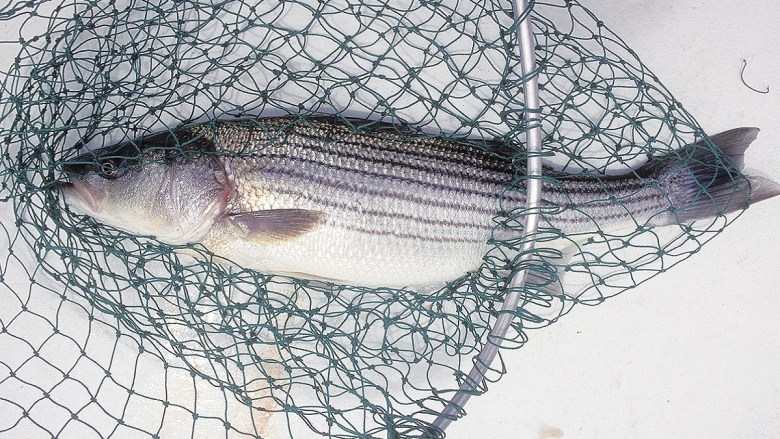
Striped bass, also known as rockfish, is one of the most popular sport and commercial fish in the Chesapeake Bay and along the mid-Atlantic coast. The commission’s changes in how to manage them, developed over the past two years, drew thousands of comments from anglers and conservationists.
A stock assessment in 2018 found striped bass were being overfished along the East Coast and that numbers of adult female fish had fallen far below target levels for sustaining the population. It warned that catch-and-release fishing by anglers was killing a significant number of fish, especially in summer when warm water temperatures and lower oxygen levels further stress fish being caught and handled.
The commission responded by ordering an 18% reduction coastwide in fishing-related mortality. It directed states to limit all anglers to one fish per day and set uniform size limits for keeping fish caught along the Atlantic coast and in the Bay, which is a major spawning and nursery ground for the migratory species. States were allowed to deviate from those uniform cutbacks, though, providing their rules reduced overall fish losses by the same amount.
Virginia canceled its spring trophy season for catching large striped bass and limited anglers the rest of the year to keeping one fish per day, down from two per day. Maryland shortened its trophy season and closed fishing for all striped bass for two weeks in the summer. It also limited anglers to keeping one fish per day, though it allowed charter boat customers to continue keeping two per trip.
Those and other catch restrictions enacted coastwide reduced the estimated mortality of fish by 28%, surpassing the commission’s goal. It’s unclear, though, if those measures have been enough to rebuild the stock by the commission’s 2029 deadline. For the last three years, Maryland’s annual surveys have found the numbers of juvenile striped bass far below average. A new coastwide stock assessment is due in the fall.
In hearings earlier this year, anglers and conservationists faulted the commission for not moving sooner to halt the fish’s decline and demanded stronger measures in response to future warning signs.
“They sent us a very clear strong signal that they want us to take action quickly when we need to,” said Martin Gary, chair of the commission’s Striped Bass Management Board. Conservation groups generally praised the commission’s action but cited shortcomings, including its decision not to require states to educate anglers about how to reduce the number of fish that die after being returned to the water.
“I just don’t understand why that wouldn’t be required when catch-and-release is a major cause of mortality,” said Allison Colden, senior Maryland fisheries scientist for the Chesapeake Bay Foundation.
Gary, who is executive secretary of the Potomac River Fisheries Commission, defended the commission’s decision to leave such measures to each state.
“This fishery is so different from place to place up and down the coast,” he said, that “honestly, it’s the only way to deal with this complexity. … We know our fisheries best [and] we’re going to work with our public to do the best we can.”
Robert T. Brown Sr., president of the Maryland Watermen’s Association, contended that the commission’s rebuilding plan is unrealistic and would lead to further cuts in commercial harvest, which over the years has been curbed more than the recreational catch. He maintained that striped bass remains abundant in the Bay.
David Sikorski, executive director of Coastal Conservation Association Maryland, acknowledged that the fishery is so varied along the coast that “it’s extremely difficult to take a broad brush and say doing this is going to really solve the problem.” What’s needed, he said, is “more precise regulation.” But even if the commission’s rebuilding targets seem overly ambitious, he said, they’re pointing in the right direction.
“I’m of the mindset that we shoot for the moon,” he said, “to land in the stars.”